

RMS Acadia
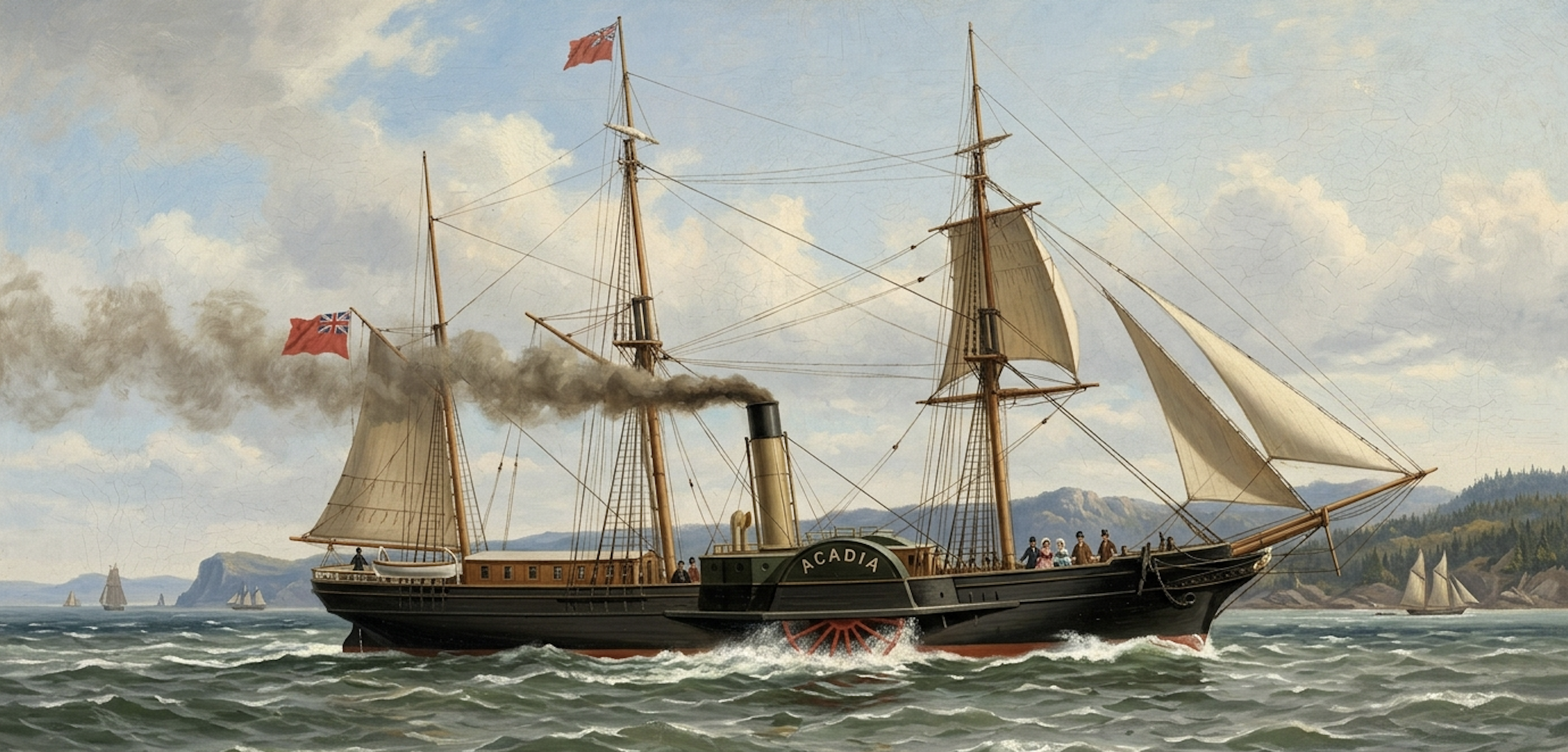 As a sister of Britannia, the Acadia played a key role in establishing the Cunard’s transatlantic steamship service. Built by Robert Duncan and Company at Port Glasgow, she was the second of the four pioneering steamers.
The Acadia was a wooden-hulled paddle steamer with a tonnage of 1,150. She was 63 metres [207 feet] long (between perpendiculars), and 10 metres [34 feet] wide, excluding paddle wheels. The ship was driven by a two-cylinder side-lever steam engine, built by Robert Napier and Sons, producing 740 ihp, allowing a speef of 9 knots (17 km/h [10 mph]).
Acadia entered service in 1840, joining Britannia and Caledonia to meet the Government’s requirements for a scheduled and reliable mail service. Acadia was known for being a fast vessel amongst the sisters, and the ship’s career took several interesting turns during her 9 years with Cunard.
However it was her post-Cunard career that might be the most interesting, as she was sold to the North German Confederation Navy after her Cunard service. There, she was converted into a frigate named Ersherzog Johann.
Following the dissolution of the North German navy, the ship was sold to W. A. Fritze and Company. She was converted back into an Atlantic liner and renamed Germania. Her return to the Atlantic in 1853 was hampered by boiler issues, and it took the ship a lengthy 24 days to reach New York. Compared to her 14 day service with Cunard in 1840 this was a big step back.
She saw military use again, when chartered for trooping during the Crimean War and later served as a troopship during the Indian Mutiny of 1857 (First War of Independence, Great Rebellion). After nearly 20 years of varied service across commercial and military owners, the ship that was Acadia was finally scrapped in 1858.

